Period property restoration in Hammersmith
Sympathetic repair of Victorian and Edwardian features, sash windows and lime plaster.
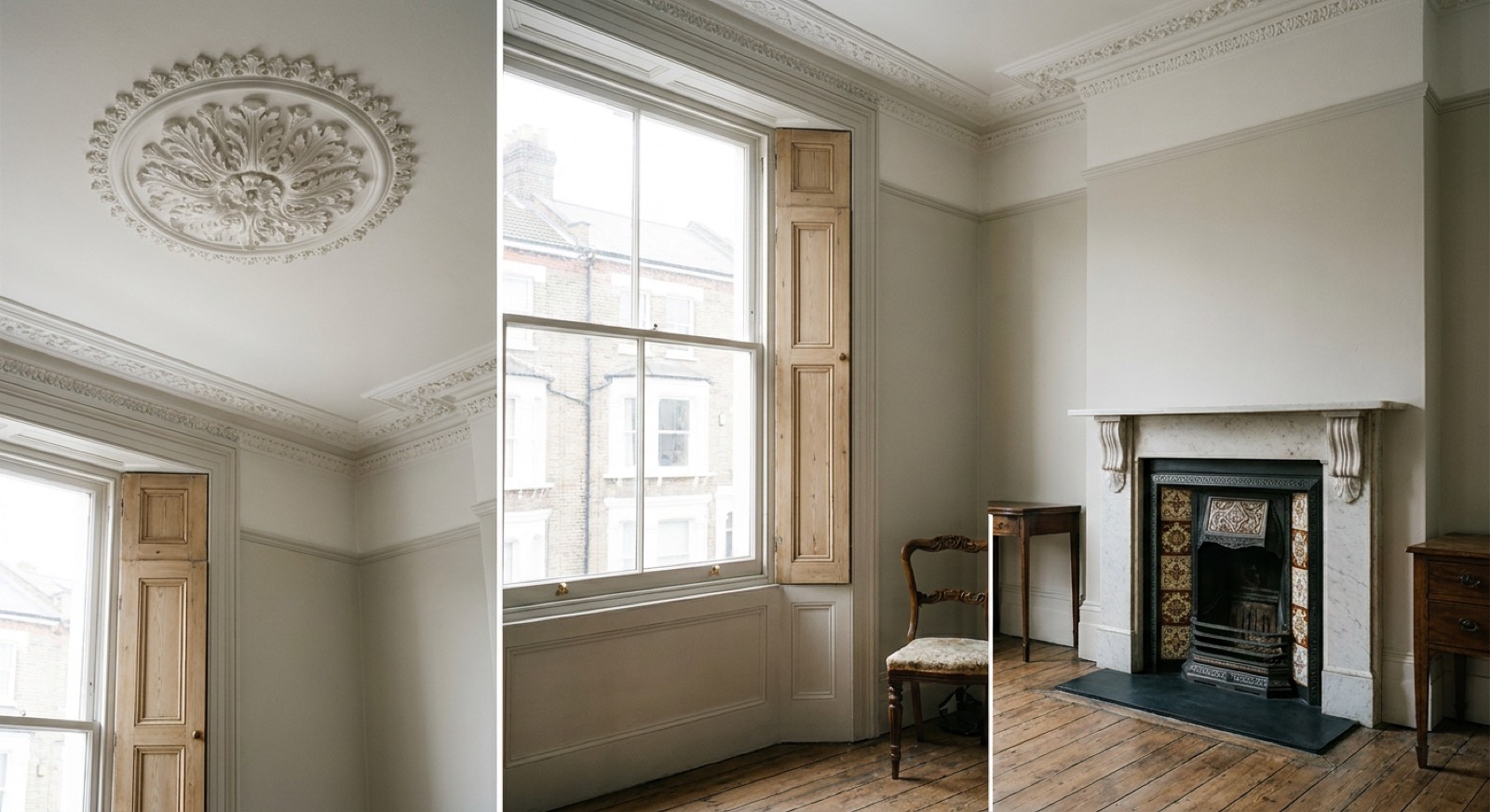
Brackenbury Village's cottages are small but architecturally consistent, and the conservation area protects that consistency — original sashes, front doors, brickwork and boundary walls. Restoration here is mostly joinery and pointing rather than grand plasterwork. Lime pointing on these solid walls matters more than usual, because the walls are thin and cement pointing traps moisture in an already marginal construction.
The properties we see in Hammersmith
Brackenbury Village is 1870s–1880s two-storey artisan cottages, small, solid-walled and with minimal floor void, which makes every services run a chase and every extension a tight site. Around Ravenscourt Park the houses are substantially larger Victorian villas, many subdivided into flats. The mansion blocks along the riverside and around Barons Court are 1900s–1930s, with shared risers, communal roofs and — critically — leases that govern what a leaseholder may alter.
Planning in Hammersmith & Fulham
Hammersmith and Fulham is our home authority, so the process and the officers are familiar. Brackenbury Village and parts of Ravenscourt Park are conservation areas. The distinctive constraint here is leasehold: mansion block alterations need landlord's consent under the lease as well as any statutory permission, and a licence to alter is a separate legal process that runs alongside planning and building control. We flag that at the outset because it is the thing that most often delays a flat project.
What period restoration involves
Restoration work on a Fulham Victorian terrace runs £1,800–£4,000 per square metre because it is slower and more skilled than standard refurbishment. The rule that saves the most money and heartache: repair original fabric wherever it can be repaired, because a replaced cornice never quite matches and a buyer can always tell.
Consider this if
- The house is in a conservation area and needs sympathetic work
- Original cornice, ceiling roses or joinery have been damaged
- Sash windows are rotten, draughty or painted shut
- Previous owners used cement render or gypsum on solid walls
- There is rising or penetrating damp in a solid-wall property
- You want to reinstate features a 1970s modernisation removed
What's included
- Survey of what is original, what is replacement and what is salvageable
- Sash window repair and draught-proofing rather than replacement
- Lime plaster and lime mortar on solid walls so they can breathe
- Cornice and ceiling rose repair, or run-in-situ matching where lost
- Careful damp diagnosis — cause first, not injected chemicals by default
- Conservation area and listed building consent applications handled
The standard we build to
Work follows Historic England guidance on breathable construction and minimum intervention, with conservation area or listed building consent obtained where the works require it.
For the full write-up on period restoration — costs, timescales, certification and the questions people ask most — see our period property restoration page. The prices and standards are the same wherever we work.
| Guide range | £1,800/m² |
| Typical duration | 4–9 months |
| Planning | London Borough of Hammersmith and Fulham |
Guide ranges for budgeting, excluding VAT and professional fees. We quote a fixed price after a site visit.
Get a fixed pricePeriod restoration in Hammersmith?
Send us the postcode and a sentence about the project. We will tell you what is achievable under London Borough of Hammersmith and Fulham and roughly what it costs.