Period property restoration in Fulham
Sympathetic repair of Victorian and Edwardian features, sash windows and lime plaster.
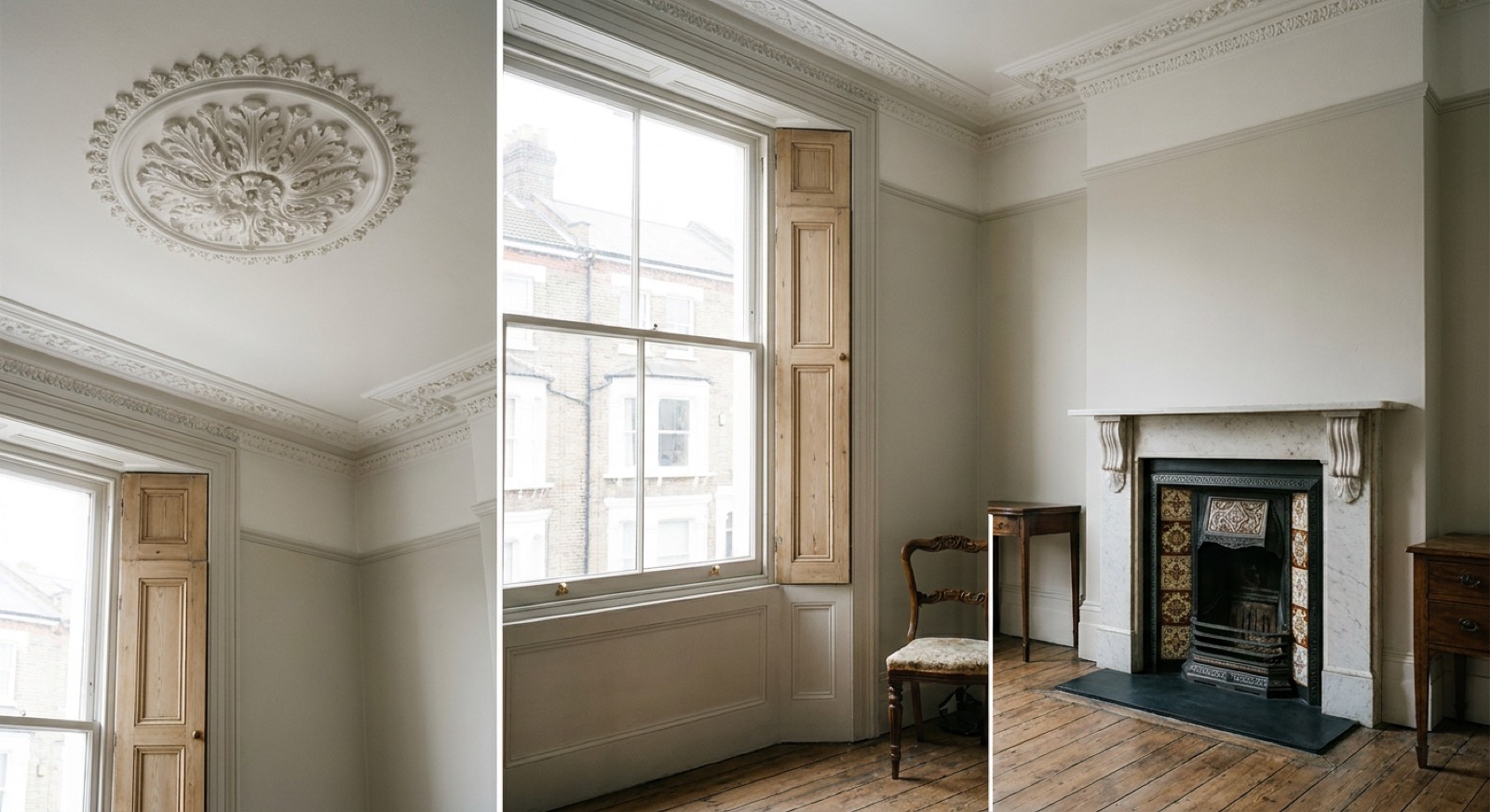
Restoration work on a Fulham Victorian terrace runs £1,800–£4,000 per square metre because it is slower and more skilled than standard refurbishment. The rule that saves the most money and heartache: repair original fabric wherever it can be repaired, because a replaced cornice never quite matches and a buyer can always tell.
Consider this if
- The house is in a conservation area and needs sympathetic work
- Original cornice, ceiling roses or joinery have been damaged
- Sash windows are rotten, draughty or painted shut
- Previous owners used cement render or gypsum on solid walls
- There is rising or penetrating damp in a solid-wall property
- You want to reinstate features a 1970s modernisation removed
What's included
- Survey of what is original, what is replacement and what is salvageable
- Sash window repair and draught-proofing rather than replacement
- Lime plaster and lime mortar on solid walls so they can breathe
- Cornice and ceiling rose repair, or run-in-situ matching where lost
- Careful damp diagnosis — cause first, not injected chemicals by default
- Conservation area and listed building consent applications handled
The standard we build to
Work follows Historic England guidance on breathable construction and minimum intervention, with conservation area or listed building consent obtained where the works require it.
Planning position
Conservation area consent may be needed for external changes; listed building consent if listed.
| Guide range | £1,800/m² |
| Typical duration | 4–9 months |
| Planning | Hammersmith & Fulham |
Guide ranges for budgeting, excluding VAT and professional fees. We quote a fixed price after a site visit.
Get a fixed pricePeriod restoration — what people ask
Why is lime plaster used instead of gypsum?
Because a solid-brick Victorian wall has no cavity and no damp-proof course, so it manages moisture by letting it evaporate back out. Lime plaster and lime mortar are vapour-permeable and allow that. Cement render and gypsum trap moisture in the wall, which is why so many Victorian houses develop damp problems shortly after being 'improved'. Using lime is not nostalgia — it is how the wall was designed to work.
Read the full answerShould I repair or replace sash windows?
Repair, in almost every case. Victorian sashes were made from slow-grown timber that is more durable than most modern replacements, and rotten sections can be spliced. A repaired, draught-proofed sash with slim double glazing performs close to a replacement unit at lower cost, keeps the property's character, and in a conservation area is often the only thing you are permitted to do.
Read the full answerDo I need permission to work on a house in a conservation area?
For internal work, generally no. For external changes — windows, doors, roof materials, front boundary walls, extensions — permitted development rights are restricted or removed, so you often need planning permission for things that would be automatic elsewhere. Several parts of Fulham are conservation areas. We check the designation and its specific Article 4 directions before designing anything.
Read the full answerPeriod restoration across south west London
The housing stock and the planning authority change what is achievable. Each area page covers what is specific to it.
Planning period restoration in Fulham?
Tell us what you have in mind and we will come back with an honest view on cost, timescale and what is achievable at your address.